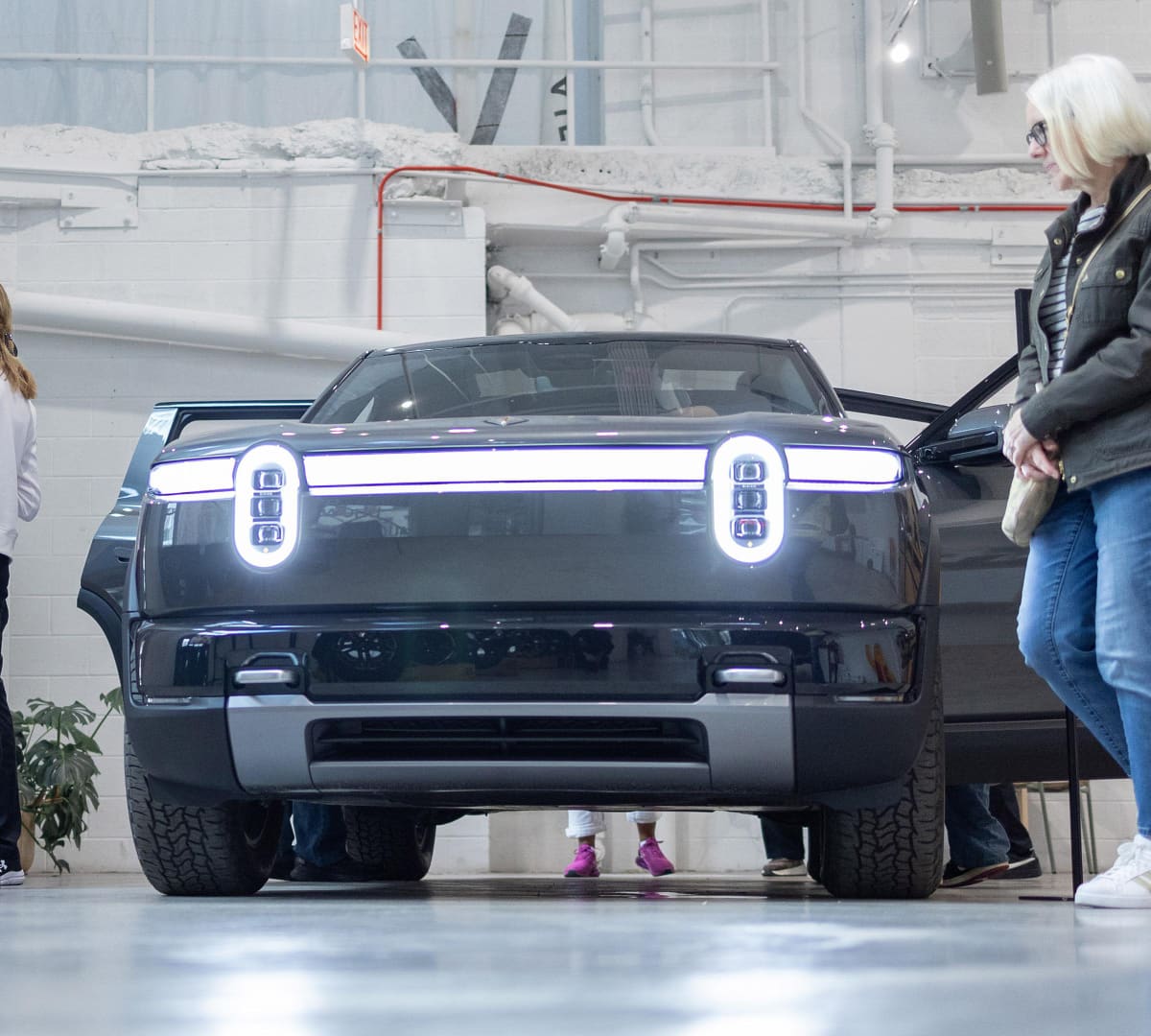
Rivian Automotive beat Wall Street's third-quarter earnings expectations as it ramped up production of its new R2 entry-level SUV, according to CNBC. The company said the R2 will lead it to profitability.
Rivian delivered a record 19,248 units from July through September. The company does not disclose deliveries by vehicle. The R2, first delivered to customers in June, has become Rivian's best-selling model, and the company said it was responsible for "much of the gain quarter-over-quarter."
The company reported a net loss attributable to common stockholders of $913 million, compared with a loss of $1.17 billion in the third quarter of 2025. Gross profit was $176 million, up from $24 million a year earlier. Adjusted earnings before interest, taxes, depreciation and amortization was a loss of $435 million, a $167 million improvement from the same period last year.
Rivian's software and services segment generated $605 million in revenue and $256 million in gross profit, a 42% margin. Its automotive operations recorded nearly $1.55 billion in revenue and a gross loss of $80 million.
Rivian revised its 2026 guidance. It now expects a pre-tax adjusted loss of between $1.75 billion and $1.85 billion, a $100 million improvement at the midpoint. It expects vehicle deliveries of 67,000 to 70,000 units, up from at least 65,000, and capital expenditures of $1.4 billion to $1.5 billion, $300 million less at the midpoint. Rivian attributed the earnings improvement to better-than-expected revenue from regulatory credit sales, an IEEPA tariff refund receivable in the third quarter, and higher expected deliveries.
Rivian reiterated that it expects the R2 to have a positive gross margin by year-end. CEO RJ Scaringe told CNBC's Phil LeBeau that "that ramp-up is critical for us getting to positive gross margin on R2." Scaringe has said the company must scale beyond current R2 production plans of 160,000 units to reach overall profitability.
Rivian ended the quarter with $5.5 billion in cash, cash equivalents and short-term investments, up from $5.3 billion at the end of the second quarter. The company remains unprofitable overall.
Shares were up roughly 7% in after-hours trading Thursday, after hitting a new 52-week low of $11.38 earlier in the day. The stock closed at $11.45, down 1.9%.